Day 9 3 May 2026
Another long (for me) bike ride. 24 miles with 420 m of ascent. A lot of that ascent was climbing the hill into Neville Holt. A lovely peaceful lane with a vicious gradient. It even merits a steep hill marker on the OS map, but even better, it has a viewpoint with a bench at the end of the steep section. Perfect for an essential breather. I can’t claim that climbing the hills is getting easier, but at least I’m still doing it and cycling further each week.
Please sponsor my bike ride here
My mother trained as a PE teacher and she believed in being tough. We never got notes to be let of PE for dodgy ankles or minor colds. In fact, we rarely were ever deemed ill enough to stay off school.” If you can get out of bed, you can go to school” was her motto. So we didn’t very often cry as children because we’d have got short shrift. The order was to put on a brave face and get on with it. Consequently, I never really subscribed to the view that girls cried and boys were brave. I didn’t realise how much that view annoyed me until the aftermath of Alice’s murder, when the expectation was that I should sob and Clive should be brave.
Within months of Alice’s murder, we had been persuaded to take part in a fly on the wall television documentary covering the homicide department in Newcastle. It was called “the Golden hour” and aimed to cover the importance of finding evidence in the first hour after a homicide takes place. Alice’s murder was their golden opportunity. The documentary gave a good account of how a homicide team works but was never intended to show anything about the stalking that had led to the murder. It taught me two things. First, that however much a producer promises you, it is all thrown away if he leaves the project and secondly, that they will film until they get what they want to see. In this case it was to see me crying and in retrospect I can see that they just kept on and on until they got what they wanted.
But crying in this documentary did not show the typical me. Of course I cried for Alice, I still do. But privately, usually on solitary walks over mountains and I rarely cry in front of people. I don’t cry in front of people because it embarrasses me and it makes them uncomfortable.
In the early days, most people just gave me a hug. I didn’t have to speak and I could avoid crying. But then people needed to talk to me about Alice, about what to do with her stuff, arrangements for her funeral and mundane, but hugely distressing administration tasks. I discovered that if I felt emotional, I could avoid crying by just stopping what I was saying, usually mid-sentence. In those early days there were a lot of silent pauses. I think my friends got used to it.
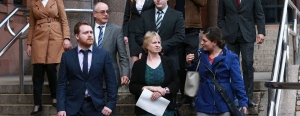
The trial in the following year was a bigger ordeal. We were very well prepared and looked after by the family liaison officers who had briefed us in advance that the trial would seem as if it was just for Trimaan Dhillon. His determination to make our family suffer was breathtaking, with numerous spiteful comments against the family and Alice’s friends, but it only hardened my resolution to stay strong. I discovered that wearing mascara, not something I usually had time for in my busy life, was surprisingly effective and I just had to think “I can’t cry, I’m wearing mascara”, to become stronger.
There is a lot of information these days to say that it is important to cry in order to deal with grief properly and I think that that is probably true. But it is also true that you sometimes have to stay strong to help other people through that very same grief, so it is not that simple. I do worry that I have become a much less sympathetic person. At the beginning of 2016, I remember feeling that I would very soon lose one of my parents and I didn’t know how I was going to cope with that. But after losing Alice and then my brother losing his stepson the following year meant that when I did lose my father in 2018 and my mother in 2025, I barely noticed.